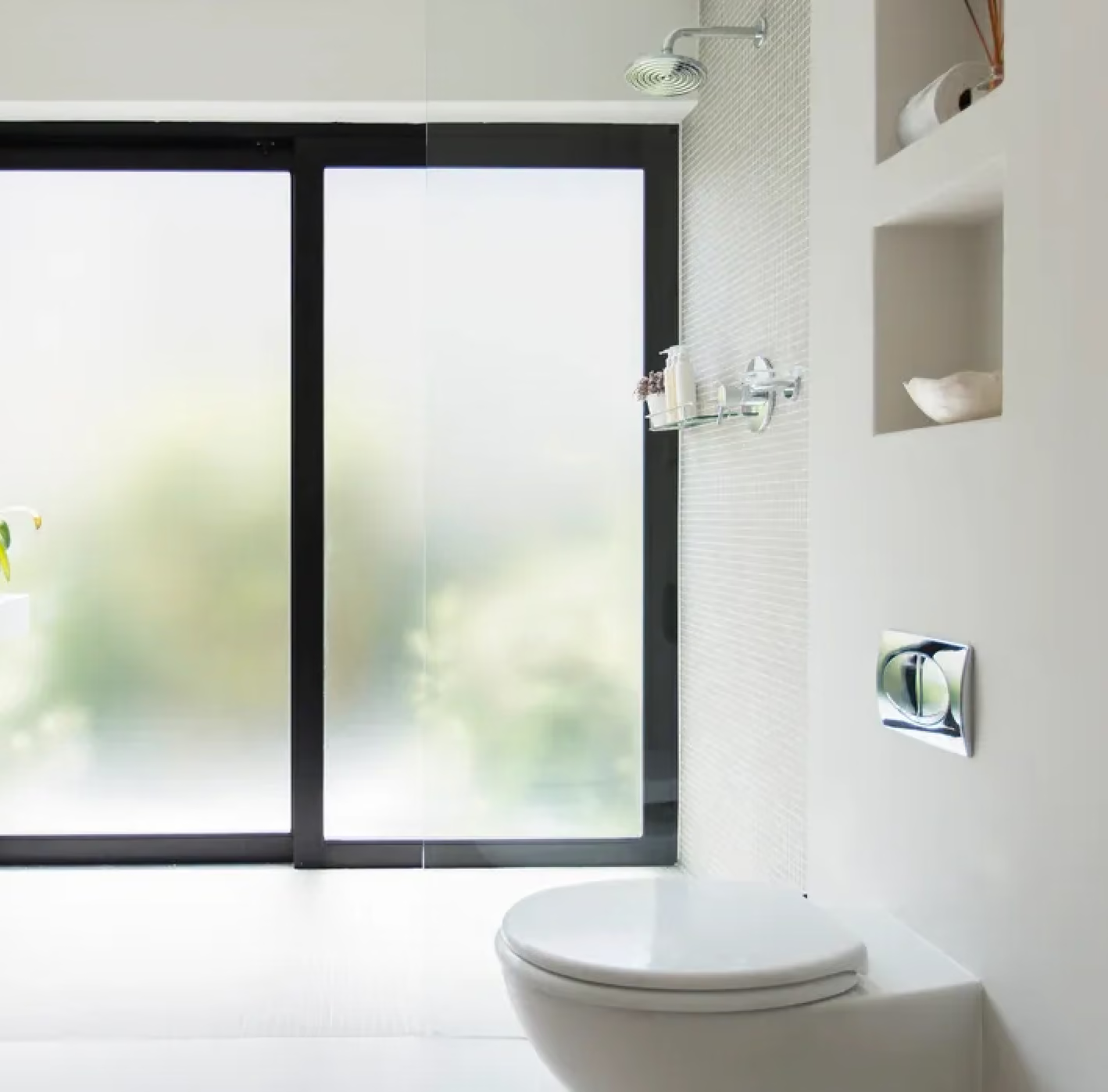
Smart glass is glazing that changes how much light passes through it when you apply electricity, heat, or sunlight. The most common type, PDLC privacy glass, seals a switchable liquid crystal layer between two sheets of glass. It turns from frosted to clear in under a fifth of a second when you switch it on, and returns to frosted when you switch it off.
We supply and install smart glass and smart film across Brisbane, the Gold Coast, and the Sunshine Coast, and we have completed more than 50 projects in homes, offices, clinics and marine. Supplying both gives us a practical view of where smart glass earns its price and where film does the same job for less; our guide to what is smart film covers the retrofit side. This guide covers the five types of smart glass, how PDLC glass switches, what it needs electrically, and what to plan, specify, and maintain. Where independent research disagrees with common sales claims, we say so.
Key figures
88%
light through when clear
11%
light through when frosted
<200 ms
to switch clear
48–65 V
AC operating voltage
0.68 → 0.63
PDLC solar heat gain, clear to frosted
≥99%
UV blocked, both states
What Is Smart Glass?
Smart glass is a glass unit that can change its light transmission, solar heat gain, or both, either on command or in response to its surroundings. Canada's ENERGY STAR window specification (2020) calls the category dynamic glazing, and defines it as a window product that can fully and reversibly change its U-factor, solar heat gain coefficient, visible transmittance, or energy rating.
The trade uses at least five names for the same idea: smart glass, switchable glass, privacy glass, dynamic glazing, and electronic glass. In Australia, one more name causes confusion. Viridian has sold a static energy-efficient glass range under the trade name SmartGlass, and that product does not switch. When a quote says "smart glass", confirm the pane changes state before you compare prices.
The key difference from smart film is where the technology lives. Smart glass arrives as a factory-laminated pane that replaces your existing glass. Smart film applies the same PDLC layer to glass you already have. That makes smart glass the new-build and reglazing option, and film the retrofit option.
What Are the Five Types of Smart Glass?
There are five types of smart glass, split into two families. Active types need electricity: PDLC, suspended particle devices (SPD), and electrochromic (EC). Passive types react to their environment: thermochromic glass responds to heat, and photochromic glass responds to sunlight. PDLC dominates privacy applications in homes and offices, and PDLC is what we supply. The rest of this guide focuses on PDLC and flags where the other types behave differently.
Only the active types switch on command, and only PDLC switches in milliseconds.Image source: Smart Electronic Tint. Data: Natural Resources Canada ENERGY STAR V5.0 (2020), with PDLC added as a separate active type.
How the five smart glass types compare
Type
Trigger
Switching time
What changes
Market status
PDLC
AC electricity
Milliseconds
Frosted to clear, 11% to 88% light
Mature, widely installed
SPD
AC electricity
0.3–0.4 seconds
Dims from under 1% to over 50% light
Commercial, niche
Electrochromic
Low-voltage DC
5–12 minutes
Tints, SHGC 0.46 down to 0.09
Commercial, highest cost
Thermochromic
Glass temperature
Gradual
Tints as the glass heats
Lab and pilot stage
Photochromic
UV and sunlight
About 3 minutes to tint
Tints in bright sun, clears slowly
Limited
How Does Smart Glass Work?
PDLC smart glass works by using an electric field to line up millions of liquid crystal droplets so light passes straight through them. The switching layer is a thin film of liquid crystal droplets held in a polymer, sandwiched between two PET sheets coated with transparent conductive indium tin oxide (ITO). The factory laminates that film between two sheets of glass with interlayers, which seal the film and bond the unit into one pane.
With no power, the droplets point in random directions, scatter the light, and the glass looks white and frosted. With power, the alternating field turns every droplet the same way and light travels through with little scattering. The glass faces protect the film on both sides, which is the main practical advantage over film applied to one face of existing glass.
Smart glass seals the same switching layer used in smart film between two protective sheets of glass.Image source: Smart Electronic Tint. Data: common PDLC laminate construction; interlayer type varies by manufacturer.
Five things happen between pressing the switch and seeing through the glass:
The switch or controller closes the circuit to the transformer.
The transformer steps 230 V mains down to 48–65 V AC.
Current flows through the busbar into the conductive coatings on each side of the film.
The alternating field aligns the liquid crystal droplets in under 200 milliseconds.
The pane stays clear for as long as the power stays on.
The other active types use different physics. SPD glass suspends rod-shaped particles in a liquid layer, and voltage lines them up to let more light through. Electrochromic glass moves lithium ions between thin ceramic layers under low DC voltage, which darkens a tungsten oxide layer and holds the tint with little power.
How Does Smart Glass Switch Between Clear and Frosted?
Standard PDLC smart glass is frosted with no power and clear with power, and it moves between the two states in well under a second. Our specification lists activation under 200 milliseconds and deactivation under 10 milliseconds. Lab testing published through the IEA Solar Heating and Cooling Programme measured PDLC switching at about 15 milliseconds, against 300–400 milliseconds for SPD.
Electrochromic glass takes 5–12 minutes to reach full tint. That suits slow daylight control on a building facade, not a meeting room door that closes and needs privacy now.
PDLC smart glass switches thousands of times faster than electrochromic glass.Image source: Smart Electronic Tint. Data: Smart Electronic Tint™ specification; IEA SHC (Lemarchand et al., 2017); KAIST photochromic research; US DOE (2023).
Is Smart Glass Clear or Frosted When the Power Is Off?
Standard PDLC smart glass is frosted when the power is off. Privacy is the fail-safe state: a power cut, a tripped circuit, or a switched-off transformer leaves a bathroom or meeting room opaque, not exposed. The trade-off is that the glass draws power only while it is clear, so clear hours set the running cost.
How Private Is the Frosted State?
Frosted smart glass blocks the view, not the light. It transmits 11% of visible light with 98% haze, so the room stays bright and nobody sees detail through it. A person standing close to the glass with a strong light behind them can show as a soft outline. If a room needs blackout for sleep or projection contrast, PDLC alone will not deliver it; SPD blocks up to 99% of light, or you can pair PDLC with a blockout blind.
Can Smart Glass Be Dimmed?
Standard PDLC glass works as a two-state product: clear or frosted. Some controllers vary the voltage to create in-between settings, but the result looks hazy rather than darker, because PDLC scatters light instead of absorbing it. For true dimming, SPD adjusts continuously from under 1% to over 50% light transmission, and electrochromic glass holds intermediate tint levels.
What Are the Electrical Requirements for Smart Glass?
PDLC smart glass runs on low-voltage alternating current, 48–65 V AC at 50–60 Hz, supplied by a transformer connected to 230 V mains. The switching layer draws about 100 mA and under 5 W per square metre while clear. It must run on AC: Microchip Technology's application note on PDLC drivers states that DC power damages the film over time, which rules out generic 12 V or 24 V LED drivers. The full electrical values sit on our technical specifications page.
Smart glass electrical requirements
Parameter
Value
Why it matters
Operating voltage
48–65 V AC
Sets the transformer output
Frequency
50–60 Hz
Matches Australian 50 Hz mains
Current draw
100 mA per m²
Sizes the transformer for each zone
Power while clear
Under 5 W per m²
Keeps running costs low
Current type
AC only
DC degrades the PDLC layer
Working temperature
−20 °C to 70 °C
Covers interior and sheltered exterior use
Only the first stage carries mains voltage, and the cable to the pane must be in place before the glazier fits the glass.Image source: Smart Electronic Tint. Data: Smart Electronic Tint™ specification; Microchip AN6205.
How Much Electricity Does Smart Glass Use?
Smart glass uses little electricity, and only while it is clear. Using our specification as the ceiling, 10 m² of glass held clear for 12 hours a day uses at most 219 kWh a year, or about $77 at an assumed 35 cents per kWh. Glass left frosted overnight costs nothing to run. A licensed electrician makes any fixed mains connection, and we tell you at the quote stage whether your job needs one.
How Do You Control Smart Glass?
You control smart glass with any device that switches the transformer's output: a wall switch, a remote, a phone app, a timer, or a building management system. The glass has no controls of its own, so the method suits the room and the people using it. Five control options cover most projects:
Wall switch: a hard-wired switch in a fixed spot, the simplest and most reliable option.
Handheld remote: an RF remote for rooms where a wall switch is awkward to reach.
Phone app: a Wi-Fi controller that switches panes from your phone and runs schedules.
Timer or scene: a programmed routine, such as frosting street-facing glass every evening.
Automation input: a relay-based controller triggered by a home or building system, confirmed for compatibility at design stage.
Zoning decides how the system feels day to day. A boardroom with six panes might frost the corridor side while the external window stays clear. Automation works when someone tunes it: in a US Department of Energy conference room fitted with automated electrochromic glass, occupants overrode the automatic setting in only 24 of 328 meetings.
How Much Does Smart Glass Cost?
Smart glass costs several times more per square metre than standard glass, and more than retrofitting smart film onto glass you already own. Price per square metre is the first question on almost every call we take, and the honest answer depends on size, glass build-up, and wiring. Our smart glass cost guide breaks the numbers down; the published benchmarks below set the scale.
The US Department of Energy puts electrochromic windows at US$50–150 per square foot, about US$540–1,615 per square metre, against US$15–30 per square foot for conventional windows. A 2023 study in Polymers puts the PDLC film layer alone at US$85–130 per square metre, before glass, lamination, transformer, wiring, and labour. Prices have moved little: in 2013, NREL quoted electrochromic glass at US$50–100 per square foot. Six factors drive a smart glass quote:
Pane size and shape.
Film colour: white, grey, or black.
Glass build-up and safety grade.
Number of zones and control type.
Electrical work and cable routes.
Access, height, and glazing logistics.
Is Smart Glass Energy Efficient?
Electrochromic smart glass can cut building energy use, but PDLC privacy glass changes solar heat gain by only a few points. A 2020 study in Solar Energy measured PDLC glazing at a solar heat gain coefficient (SHGC) of 0.68 clear and 0.63 frosted. Electrochromic glass ranges from 0.41–0.46 clear down to 0.09–0.12 tinted. A lower SHGC means less solar heat enters the room.
Buy PDLC glass for privacy and daylight; buy electrochromic or high-performance glazing for heat.Image source: Smart Electronic Tint. Data: Hemaida et al., Solar Energy (2020); US DOE Building Technologies Office (2023).
Windows matter to comfort in Australia. The Australian Government's Your Home glazing guide states that up to 87% of a home's heat gain and up to 40% of its heating energy loss happen through windows. Energy labels miss the switching benefit: the ENERGY STAR specification rates dynamic glazing in its clearest state only.
What PDLC glass does well is protect interiors and control glare. It blocks at least 99% of UV in both states, and the frosted state diffuses harsh direct light. Data-sheet infrared-blocking figures do not translate one-to-one into less heat in the room, so ask for measured SHGC in both states if heat is your main problem.
What Are the Limitations of Smart Glass?
Smart glass has seven practical limitations, and knowing them before you order prevents most disappointments. Modern PDLC is clearer than many buyers expect; customers regularly tell us they are surprised how little haze they see. The product still has limits:
Clarity: switchable glass is never as clear as plain float glass; the clear state carries 3% haze.
Viewing angle:a Texas Instruments white paper describes an inherent off-axis haze in PDLC, so the clear state looks softer from steep angles.
Privacy level: frosted diffuses the view but lets about 11% of light through, so it is not blackout.
Power dependence: the clear state needs continuous power.
Panel size: our standard maximum is 1,800 × 2,700 mm, with larger sizes on application.
No retrofit: smart glass replaces the existing pane and cannot be cut down on site.
Supplier risk: warranties depend on the company behind them; electrochromic maker View, Inc. entered Chapter 11 reorganisation in April 2024 before emerging as a private company.
Light direction changes how any PDLC installation looks. A switchable glass wall under a roof window shows more haze, and nearby beams can cast visible shadows on the frosted face. We check light sources behind and above each pane at the site measure.
Planning a project?
Get a clear, written smart glass quote in South East Queensland.
Send us your plans or opening sizes. We'll tell you whether smart glass or smart film suits each opening. We quote clearly and book a firm date.
Smart glass lifespan depends on the technology, the lamination quality, and whether moisture reaches the laminated edge. Durability evidence varies widely by type. A dye-based electrochromic device passed more than 150,000 switching cycles over 5,000 hours under the ASTM E2141 accelerated-ageing standard. NREL's perovskite thermochromic prototype had completed 200 cycles, and a photochromic glass patent notes some organic photochromic films degrade in about 5 years.
For PDLC glass, three factors decide service life: a sealed edge that keeps water out, AC-only power, and operation within the −20 °C to 70 °C working range. Smart Electronic Tint™ products and components are produced and laminated in Australia. Every project carries a 3-year product warranty, passed through from our manufacturing partner, and a 5-year workmanship warranty on our installation.
Where Is Smart Glass Used?
Smart glass fits any space that needs privacy some of the time and daylight or views the rest of the time, especially where the glass is being replaced or built new. The table covers the spaces we see most, and our smart glass applications guide goes deeper on each one.
Where smart glass works and why
Space
What smart glass solves
Typical type
Bathrooms and ensuites
Privacy without losing natural light
PDLC glass
New-build street-facing windows
Privacy from neighbours or a main road, day and night
PDLC glass
Meeting rooms and offices
Open-plan light with private meetings on demand
PDLC glass or film
Clinics and consult rooms
Patient privacy without curtains or blinds
PDLC glass
Retail and hospitality
Reveal-and-hide displays, private dining
PDLC glass
Pool houses and enclosures
Privacy around the pool without blinds in humid air
PDLC glass, build confirmed per job
Exterior windows and outdoor screens
Privacy where weather reaches the glass
PDLC glass, build confirmed per job
Glazed garage doors
Frosted from the street, clear for daylight
PDLC glass with a power path on the moving door
Boats and yachts
Cabin and bathroom privacy on board
PDLC or SPD glass, marine build confirmed per job
Secure and confidential rooms
Blocks sightlines to people, screens, and whiteboards
PDLC glass
Curved, angled, and custom shapes
Openings where blinds and curtains cannot fit
PDLC glass laminated to a template
Facades and skylights
Solar heat and glare control
Electrochromic or SPD
Cars, trucks, and aircraft
Dimmable windows and roofs
SPD
Four of these uses put glass in contact with water, salt, chlorine, or weather: pools, exterior windows, garage doors, and boats. Lamination protects the film on both faces, which is why we recommend glass over film there. The edge seal stays the weak point, so we confirm the glass build-up and edge detail with our manufacturing partner for each job before we quote. Garage doors add one more step: the cable has to reach a panel that moves.
Custom shapes are laminated to a template, up to our standard maximum of 1,800 × 2,700 mm, with larger sizes on application. For confidential rooms, frosted glass stops people seeing in; it does not stop sound or wireless signals, so pair it with acoustic glazing where conversations matter.
SPD glass appears in production vehicles and aircraft, including Mercedes-Benz, McLaren, and HondaJet, according to licensor Research Frontiers' 2025 annual report.
What Is the Difference Between Smart Glass and Smart Film?
Smart glass and smart film use the same PDLC technology; smart glass arrives as a new laminated pane, while smart film adheres to glass you already have. We supply both, and film is our focus for retrofits. Smart glass is our choice where water or weather reaches the glass, or where a new build wants a factory-laminated unit from day one. The full comparison sits in our smart glass vs smart film guide.
Lamination protects the film on both faces, which is why smart glass suits wet and exposed locations.Image source: Smart Electronic Tint. Data: Smart Electronic Tint™ product construction.
Smart glass and smart film at a glance
Factor
Smart glass
Smart film
Installation
Replaces the glass pane
Applied to existing glass
Best timing
New builds and reglazing
Retrofits and fit-outs
Relative cost
Higher
Lower
Wet or exterior glass
Suited, sealed in laminate
Not suited
If damaged
Replace the pane
Replace the film
One pattern repeats in our enquiries. A customer asks for smart glass, sees the price, and asks whether film can do the same job. When the existing glass is sound, dry, and on the interior face, it usually can.
How Is Smart Glass Different From Conventional Window Tint?
Conventional window tint is fixed: it darkens or reflects glass permanently, while smart glass switches between clear and private on demand. Static tint suits a west-facing window that overheats every afternoon, because it rejects solar heat around the clock at a lower price. Smart glass suits a window where you want the full view at some times and privacy at others. Our smart tint vs window tint guide covers the comparison in detail.
Smart glass compared with conventional window tint
Factor
Smart glass
Conventional tint
Privacy
Switchable, day and night
Fixed; reflective tint reverses at night
Winter sun
Clear state admits it
Blocked all year
Heat control
Modest for PDLC
Strong with solar-control films
Power
Needs a transformer
None
Cost
Highest
Lower
Fixed tint cuts winter sun as well as summer heat. In a US General Services Administration field test reported by Berkeley Lab, a static solar-control film raised total heating and cooling energy by 3–7% because it blocked welcome winter solar gain. Climate decides how much that matters: heating makes up about 80% of the heating-and-cooling load in Melbourne against about 25% in East Sydney.
What Should You Plan Before a Smart Glass Project?
A smart glass project succeeds or fails on decisions made before the glass is ordered, because every pane is laminated to size and the cable must be in the frame before the glazier arrives. Builders, glaziers, and electricians work in sequence, and smart glass adds a power step most glazing jobs do not have. Our installation team works through these eight steps on every job:
Define the job: privacy, glare, heat, or a mix.
Measure each opening against the maximum panel size.
Check light sources behind and above each pane.
Plan transformer location, cable routes, and switch positions before walls close.
Choose frames or fixings that protect the busbar edge and hide the cable exit.
Decide zones and control type.
Book a licensed electrician for the mains connection.
Commission and hand over: test every zone, demonstrate the controls, and issue warranty documents.
Lamination to size is the step that sets the lead time, so confirm dimensions before walls close.Image source: Smart Electronic Tint. Data: Smart Electronic Tint™ installation process.
Timing depends on the build stage. A straightforward residential job moves from enquiry to signed quote in about two weeks, while new builds follow the construction program. We quote clearly and book a firm date.
What Should a Professional Smart Glass Specification Include?
A professional smart glass specification states performance in both states, the electrical system, the glass build-up, and who backs the warranty, each with a measured value. Rating procedures from the US National Fenestration Rating Council require dynamic glazing to be rated in both its most and least transmitting states, and a sound specification follows the same logic. Our smart glass specification guide expands each line into specification-ready wording.
Visible light transmission and haze, clear and frosted
SHGC and U-value for both states
Glass build-up, thicknesses, and interlayer type
Safety glass selection to AS 1288
Maximum panel size and tolerances
Voltage, frequency, and load per square metre
Zones, controls, and transformer locations
Warranty terms and the company backing them
In Australia, the National Construction Code requires glazing to be rated to Australian Fenestration Rating Council protocols, with WERS providing total-system ratings of glass and frame together, according to the Australian Glass and Window Association. Ask whether a smart glass unit carries a rating before you rely on it for NatHERS or Section J compliance.
Australia starts from a low glazing-performance baseline, so rated units matter more here.Image source: Smart Electronic Tint. Data: RMIT University for Sustainability Victoria, Upscaling High-Performance Windows in Victoria.
How Do You Maintain Smart Glass?
Smart glass needs the same cleaning as ordinary glass, plus care around the laminated edge and the electrical connection. The PDLC film sits sealed inside the laminate, so both glass faces clean like any other pane. The weak points are the edge seal, the connector, and the transformer.
Clean with a soft microfibre cloth and a pH-neutral glass cleaner.
Spray the cloth, not the glass, so liquid stays away from the edge and connector.
Skip scrapers, abrasive pads, and solvent cleaners on the glass and edge seal.
Inspect the edge seal and connector twice a year for moisture, cracking, or discolouration.
Keep the transformer dry, ventilated, and clear of stored items.
Keep drilling, screws, and fixings away from the pane edge during later renovations.
How Do You Troubleshoot Common Smart Glass Problems?
Most smart glass faults trace back to the power supply, a connection, or moisture at the edge, and you can check the first two safely yourself. Start with one question: do other panes on the same switch still work? The answer tells you whether the fault sits in the supply or at the pane. Never open the transformer or touch mains wiring; that work belongs to a licensed electrician.
One question splits most faults into a supply problem or a pane problem.Image source: Smart Electronic Tint. Data: Smart Electronic Tint™ service process.
Smart glass troubleshooting guide
Symptom
Likely cause
What to do
Whole zone stays frosted
No power to the zone
Check the switch, breaker, and controller light
One pane stays frosted
Loose connector or cable at that pane
Book a service call
Patchy clearing
Busbar contact or lamination fault
Photograph the area and book a service call
Milky when clear
Steep viewing angle or bright backlight
View square-on; this is normal PDLC behaviour
Flicker or buzzing
Loose connection or unsuitable driver
Switch off and book a service call
Edge bubbles or discolouration
Moisture at the edge or lamination fault
Photograph, keep dry, and report it
If a basic check does not fix the problem, contact us with your install date and a photo of the pane. Faults covered by warranty follow the terms in your quote.
Is Smart Glass Worth It?
Smart glass is worth it when you want privacy on demand without losing daylight, and the glass is due for replacement or not built yet. It is rarely worth it as an energy upgrade on its own. Research on PDLC windows in a hot, dry climate found annual air-conditioning savings of about US$102, a payback of about 12.7 years. The return comes from what the room does for you: a bathroom that stays bright, an office that stays open, a street-facing living room without blinds.
It fits best when three things are true. You need privacy only part of the time, you want no blinds or curtains in the sightline, and the opening is getting new glass anyway. If your existing glass is sound, dry, and on an interior face, our smart film gives you the same switching for less.
Frequently Asked Questions About Smart Glass
Can Smart Glass Be Retrofitted to Existing Windows?
No. Smart glass is a complete laminated pane, so the existing glass comes out and the new unit goes in. Smart film is the retrofit option: it adheres to the glass you already have and switches the same way.
What Happens to Smart Glass in a Power Cut?
Standard PDLC smart glass turns frosted when power stops, so the room stays private during an outage. It returns to clear when power returns and the switch is on.
What Powers Smart Glass?
A transformer converts 230 V mains power to 48–65 V AC at 50–60 Hz. The PDLC layer draws about 100 mA and under 5 W per square metre while clear, and nothing while frosted. Any fixed mains wiring needs a licensed electrician.
Is Smart Glass Safe?
Smart glass is a laminated unit, so the interlayers hold fragments together if the glass breaks. The pane runs on low-voltage AC, and a licensed electrician makes the 230 V mains connection. Glass selection for each opening follows AS 1288.
What Warranty Comes With Smart Glass?
Smart Electronic Tint™ carries a 3-year product warranty, passed through from our manufacturing partner, and a 5-year workmanship warranty on our installation.
How Long Is the Wait for a Smart Glass Installation?
Smart glass is laminated to size for each opening, so lead time depends on the number of panes, their sizes, and the build stage. It takes longer than smart film. We quote clearly and book a firm installation date in writing.
Get a written smart glass quote and a firm install date for your project.