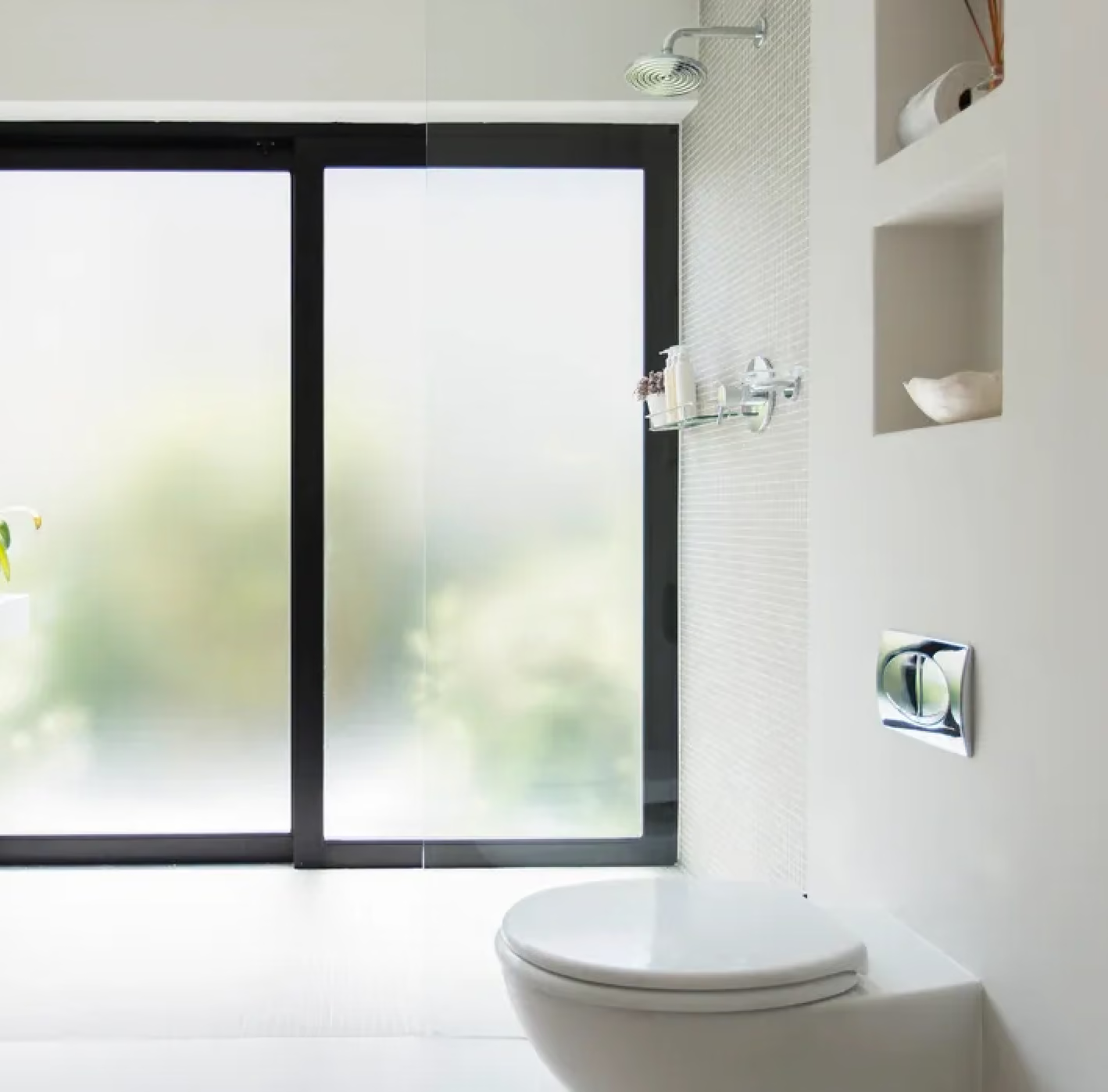
Smart film is a thin, self-adhesive switchable layer that turns existing glass from frosted to clear when an electric current passes through it. Most smart film on the market, including our Smart Electronic Tint™, uses polymer dispersed liquid crystal (PDLC) technology. You get privacy on demand, daylight in both states, and no blinds or curtains on the glass.
We install smart film across Brisbane, the Gold Coast, and the Sunshine Coast, and we have completed more than 50 projects in homes, offices, clinics and Marine. This guide covers what we explain on every site visit: how the film works, what it needs electrically, how you control it, where it falls short, and what to plan before you book. Where independent research disagrees with common sales claims, we say so.
Key figures
88%
light through when clear
11%
light through when frosted
<200 ms
to switch clear
48–65 V
AC operating voltage
<5 W/m²
power while clear
≥99%
UV blocked, both states
What Is Smart Film?
Smart film is a switchable PDLC laminate that bonds to the inside face of existing glass and changes from opaque white to transparent on command. A low-voltage AC current from a small transformer switches it clear. Removing the current returns it to frosted.
The industry uses several names for the same product: switchable film, PDLC film, electronic privacy film, and smart tint. Smart Electronic Tint™ is our name for the film we produce and laminate in Australia with our manufacturing partners.
The key difference from smart glass is where the technology lives. Smart film goes onto glass you already have. Smart glass seals the same PDLC layer between two sheets of glass at the factory, which means replacing the pane. That makes film the retrofit option, and it explains why “Can it be retrofitted?” is one of the five questions we hear on nearly every sales call.
Smart film is a thin stack of protective, conductive, and switching layers that bonds to existing glass.Image source: Smart Electronic Tint. Data: Smart Electronic Tint™ product construction.
What Is Smart Film Made Of?
Smart film is a stack of five functional layers plus an adhesive backing:
Outer PET film : a clear polyester layer that protects the surface.
Conductive coating : a transparent indium tin oxide (ITO) layer that spreads current across the pane.
PDLC layer : liquid crystal droplets suspended in a cured polymer, the part that switches.
Second conductive coating : the opposite electrode that completes the circuit.
Inner PET film : a second protective layer.
Clear adhesive : bonds the film to the glass once the liner is removed.
Copper busbars along one edge connect both conductive coatings to the power cable. That edge is the most sensitive part of the film, which is why installation quality matters as much as film quality.
What Types of Switchable Technology Exist?
There are three main switchable glazing technologies: PDLC, suspended particle devices (SPD), and electrochromic (EC). PDLC scatters light to create privacy and switches in milliseconds. SPD darkens like sunglasses, adjusting from under 1% to over 50% light transmission, according to a Research Frontiers SEC filing. Electrochromic glass tints through an electrochemical reaction and takes 5–12 minutes to change fully. Retrofit privacy film is PDLC in most cases, and Smart Electronic Tint™ is a PDLC product.
How Does PDLC Smart Film Work?
PDLC smart film works by using an electric field to line up millions of microscopic liquid crystal droplets, which lets light pass straight through. Without power, the droplets point in random directions. Each droplet bends light at a slightly different angle, which scatters it and produces the frosted white look. With power, the droplets align with the field and match the optical properties of the surrounding polymer, and light travels through without scattering.
Scattering is the reason smart film gives privacy without darkness. Light still enters the room in the frosted state, with 11% of visible light passing through our standard white film. That light loses the image detail your eye needs to see shapes, faces, and text. Smart film diffuses light; it does not block it.
Without power, random droplets scatter light. With power, aligned droplets let light through.Image source: Smart Electronic Tint. Data: Smart Electronic Tint™ technical specification.
What Happens in the Frosted State?
In the frosted (off) state, our film transmits 11% of visible light, shows 98% haze, blocks 90% of infrared, and blocks at least 99% of UV. Haze measures how much light strays from a straight path. At 98%, almost nothing on the far side stays recognisable. The frosted state needs no power, which makes it the default and the fail-safe position.
What Happens in the Clear State?
In the clear (on) state, our film transmits 88% of visible light with 3% haze, blocks 35% of infrared, and still blocks at least 99% of UV. The 3% haze figure matters. Many people expect a milky clear state, and the most common reaction we hear on site is surprise at how clear the glass looks. Independent research supports this range: a 2023 study in Polymers measured 81.2% visible transmission in the clear state for a 0.1 mm PDLC film.
Smart Electronic Tint™ blocks at least 99% of UV whether it is switched on or off.Image source: Smart Electronic Tint. Data: Smart Electronic Tint™ technical specification.
How Does Smart Film Switch Between Clear and Frosted?
Smart film switches in a fraction of a second: our film turns clear in under 200 milliseconds and returns to frosted in under 10 milliseconds. The change looks instant to the human eye. There is no fade, no warm-up, and no practical daily limit on how many times you switch it.
Speed separates PDLC from the other switchable technologies. Lab testing published through the IEA Solar Heating and Cooling Programme recorded PDLC switching in about 15 milliseconds, while SPD needed 300–400 milliseconds. Electrochromic glass takes 5–12 minutes. The gap explains why electrochromic glass suits building façades on automated schedules, and PDLC suits rooms where people want privacy the moment a door closes.
PDLC smart film switches thousands of times faster than electrochromic glass.Image source: Smart Electronic Tint. Data: Smart Electronic Tint™ specification; IEA SHC (Lemarchand et al., 2017); US DOE (2023).
Is Smart Film Clear or Frosted When the Power Is Off?
Standard smart film is frosted when the power is off. Privacy is the fail-safe state: a power cut, a tripped circuit, or a switched-off transformer leaves the glass opaque, not exposed. The trade-off is that the film draws power only while it is clear. If you want clear glass for 12 hours a day, you run it for 12 hours a day.
Reverse-mode PDLC films, clear without power and frosted with power, exist for glass that stays clear most of the time. They cost more and are less common. We settle the default state at the quote stage because it decides running cost, fail-safe behaviour, and which rooms suit film.
Can Smart Film Be Dimmed?
Smart film works as a two-state product in most installations: fully frosted or fully clear. Some drivers vary the voltage to produce partial haze, but the result can look uneven across large panes and does not match the smooth darkening of SPD or electrochromic glass. If you need adjustable darkness for a skylight or a west-facing façade, those technologies fit the brief better than PDLC.
What Are the Electrical Requirements for Smart Film?
Smart film runs on low-voltage alternating current: 48–65 V AC at 50–60 Hz, drawing about 100 mA and under 5 W per square metre. A transformer, sometimes called a driver, steps Australian 230 V mains down to that range. The film must run on AC. Microchip Technology's application note on PDLC drivers states that DC power damages the film over time, which rules out battery packs and DC supplies.
Every installation follows the same five-stage power chain:
Mains supply: a 230 V power point or hard-wired circuit near the glass.
Transformer: steps mains down to 48–65 V AC.
Controller: a switch, remote receiver, timer, or relay that turns the output on and off.
Low-voltage cable: runs to the edge of the pane, hidden in the frame, reveal, or wall.
Busbar connection: joins the cable to the conductive layers along one edge of the film.
Any fixed mains wiring, such as a new power point or a hard-wired transformer, must be done by a licensed electrician. We tell you at the quote stage whether your job needs one. The full electrical values sit on our technical specifications page.
Only the first stage carries mains voltage. Everything after the transformer runs at low-voltage AC.Image source: Smart Electronic Tint. Data: Smart Electronic Tint™ specification; Microchip AN6205.
How Much Electricity Does Smart Film Use?
Smart film on a typical window uses about as much power as one LED downlight. Our film draws under 5 W per square metre, and only while it is clear. Here is a worked example, using our specification as the ceiling:
10 m² of film × 5 W = 50 W while clear
50 W × 12 clear hours a day = 0.6 kWh per day
0.6 kWh × 365 days = 219 kWh per year
219 kWh × an assumed 35 cents per kWh = about $77 per year
Rooms that stay frosted most of the day, such as ensuites, cost a fraction of that figure. Independent sources put PDLC film at up to 10 W per square metre, which would double the example in a worst case.
How Is the Transformer Sized?
The transformer is sized to the total film area it powers, plus spare capacity. Smart film behaves like a capacitor, which is why drivers are rated in volt-amperes (VA) rather than watts. At 100 mA per square metre and 60 V, each square metre needs about 6 VA, and 10 m² needs roughly 60 VA before headroom. One transformer can run several panes in the same zone. The transformer needs a ventilated, accessible spot, such as a ceiling space, cupboard, or joinery cavity, within a short cable run of the glass.
How Do You Control Smart Film?
You control smart film with any device that can switch the transformer's output on and off: a wall switch, a remote, a timer, a smart relay, or a building management system. The film has no controls of its own. Control lives in the hardware between the mains and the film, which lets you pick the method to suit the room.
Control choice matters more than most buyers expect. A US Department of Energy report on automated electrochromic windows at a federal building in Sacramento found that early control software left windows fully tinted too often, and lighting energy rose 62%. The lesson carries across to film: switching logic decides whether people enjoy the glass or fight it.
Common smart film control methods
Control method
Best for
What to plan
Wall switch
Bathrooms, bedrooms, and offices
A switch position and a cable path
Handheld remote
Retrofits with no wall access
Receiver within range of the remote
Timer
Shopfronts and receptions
Schedules that match trading hours
Smart relay
Homes with an existing smart system
Compatibility with your platform
Building management system
Offices, clinics, and meeting rooms
A relay or dry-contact interface
Group panes that should always switch together into one zone, and give each zone its own control. We confirm the control hardware for every zone in your written quote.
How Much Does Smart Film Cost?
Smart film costs more than conventional tint and less than smart glass, and installers price it per square metre plus the power and control hardware. A 2023 peer-reviewed study in Polymers put commercial PDLC film at US$85–130 per square metre for the material alone, before the transformer, wiring, and installation. Installed prices vary with the job, which is why a per-square-metre rate on its own can mislead.
Six factors drive the final price:
Total film area.
Number of separate panes.
Film colour: white, grey, or black.
Transformer count and control method.
Pane sizes beyond the 1,800 × 2,700 mm standard maximum.
Electrical work, site access, and working height.
Pane count matters because each piece needs its own cut, busbar, and connection. Our residential projects typically fall between $1,000 and $5,000, and commercial projects between $3,000 and $20,000+. For pricing detail, running costs, and quote comparisons, read our guide to smart film cost.
What Are the Limitations of Smart Film?
Smart film has six practical limitations: it is not blackout, it needs power to stay clear, it controls heat only modestly, it shows slight haze at sharp angles, it has size limits, and it needs smooth, dry, interior glass. We walk every client through these before quoting, because each one decides whether film is the right product.
Not blackout: frosted film transmits 11% of visible light, which suits privacy, not sleep-grade darkness.
Power to stay clear: standard film is frosted without power, and clear glass carries a small running cost.
Modest heat control: total solar heat gain changes little between states (see below).
Off-angle haze:a Texas Instruments white paper describes an inherent off-axis haze in PDLC, and the clear state looks softer from sharp angles.
Size limits: our standard maximum is 1,800 × 2,700 mm per piece, with larger sizes on application.
Glass type and location: film needs smooth, flat, interior glass that stays dry.
Does Smart Film Reduce Heat?
Smart film reduces some heat, but less than many sellers claim, and you should not buy it as an energy upgrade. Our frosted film blocks 90% of infrared, which cuts the direct heat you feel on your skin near the glass. Total heat gain changes less. A 2020 study in Solar Energy measured a solar heat gain coefficient (SHGC) of 0.68 for PDLC glazing when clear and 0.63 when frosted. Electrochromic glass ranges from 0.09 to 0.46.
Most energy-saving figures online, such as 10–20% building energy reductions, come from electrochromic glass studies. They do not transfer to PDLC film. Buy smart film for privacy, daylight, UV protection, and glare softening. If heat is your main problem, solar-control products fit the brief better.
PDLC changes solar heat gain by 0.05. Electrochromic glass changes it by up to 0.37.Image source: Smart Electronic Tint. Data: Hemaida et al., Solar Energy (2020); US DOE Building Technologies Office (2023).
How Private Is Smart Film at Night?
Frosted smart film keeps rooms private at night because it diffuses light in both directions, unlike reflective tint. Faces, text, and detail stay hidden. A person standing close to the glass in a bright room can show as a soft, blurred silhouette from outside, because light still passes through. For bathrooms and street-facing bedrooms, frosted film gives privacy comparable to obscure glass. Sleep-grade darkness needs a separate blackout solution.
Planning a project?
Get a clear, written smart film quote in South East Queensland.
Send us your pane sizes and a few photos. We install Smart Electronic Tint™ across Brisbane, the Gold Coast, and the Sunshine Coast. We quote clearly and book a firm date.
Smart film is used anywhere glass needs to switch between open and private, including bathrooms, bedrooms, home offices, meeting rooms, medical rooms, shopfronts, and hospitality venues. Around three in four of our projects are residential, and the rest are commercial fit-outs. The use case decides the film colour, the default state, and the control method.
Where smart film works and why
Space
What smart film solves
Typical control
Bathroom and ensuite windows
Neighbour and street privacy with daylight
Wall switch
Street-facing bedrooms
Night privacy without curtains
Wall switch or remote
Internal glass walls and doors
Open-plan light with private moments
Wall switch
Meeting rooms and boardrooms
Confidential meetings on demand
Wall switch or BMS
Medical and consulting rooms
Patient privacy during treatment
Wall switch
Shopfronts and receptions
After-hours privacy and projection displays
Timer
Frosted PDLC doubles as a rear-projection screen, which lets retail and hospitality venues run video on glass. Our smart film applications guide covers each space in detail, with design notes for architects and interior designers.
What Is the Difference Between Smart Film and Smart Glass?
Smart film is a PDLC layer applied to existing glass; smart glass is the same PDLC layer laminated between two sheets of glass in a factory. Both switch the same way. The difference is how the technology reaches your building, and that changes cost, timing, and where you can use it.
Smart film and smart glass at a glance
Factor
Smart film
Smart glass
Installation
Applied to existing glass
Replaces the glass pane
Best timing
Retrofits and fit-outs
New builds and reglazing
Relative cost
Lower
Higher
Wet or exterior glass
Not suited
Suited, sealed in laminate
Trades involved
Film installer and electrician
Glazier, installer, and electrician
We supply both, and film is our focus. One line we hear from clients sums up the choice: they wanted smart glass, found the price too high, and asked about film instead. We recommend smart glass where the location demands it, such as glass exposed to water or weather. The full comparison sits in our smart film vs smart glass guide.
How Is Smart Film Different From Conventional Window Tint?
Conventional window tint is fixed: it darkens or reflects glass permanently, while smart film switches between clear and private on demand. Tint excels at solar control. Smart film excels at privacy you can switch off.
Smart film compared with conventional window tint
Factor
Smart film
Conventional tint
Privacy
Switchable, day and night
Fixed; reflective tint reverses at night
Clear view
Available on demand
Permanently darkened
Heat control
Modest
Strong with solar-control films
Power
Needs a transformer
None
Cost
Higher
Lower
Reflective tint gives daytime privacy because the outside is brighter than the inside. At night, with the lights on, the effect reverses and people outside can see in. Frosted smart film does not depend on light levels. Our smart film vs window tint guide compares both in depth.
Three questions settle most choices between smart film, smart glass, and conventional tint.Image source: Smart Electronic Tint. Data: Smart Electronic Tint™ project assessment process.
What Should You Plan Before a Smart Film Project?
Plan four things before a smart film project: the glass, the power, the controls, and the timing. Most delays we see come from power that was not planned early, such as a transformer with nowhere to go or a cable with no route to the glass. Builders and architects save the most by settling these at framing stage, before plaster and joinery close the walls.
Measure every pane and note the glass type.
Confirm the film colour and default state.
Locate power and a transformer position.
Plan the low-voltage cable route to each pane.
Choose a control method for each zone.
Book the install and any electrical work.
Our installation service covers each step, from site measure to commissioning, for residential and commercial projects across South East Queensland.
Power preparation is the step most projects underestimate.Image source: Smart Electronic Tint. Data: Smart Electronic Tint™ installation process.
How Do You Maintain Smart Film?
Maintain smart film by cleaning it gently with a microfibre cloth and a pH-neutral cleaner, and by keeping blades, abrasives, and ammonia away from the surface. The PET face protects the film, but scratches and harsh chemicals can damage the conductive layers beneath it.
Wait for the adhesive to cure before the first clean; your installer will give you the timing.
Spray a pH-neutral cleaner onto a microfibre cloth, not onto the film.
Wipe in straight lines with light pressure.
Dry the surface with a second clean cloth.
Keep the busbar edge dry and untouched.
Avoid ammonia-based glass cleaners, scourers, razor scrapers, and stickers or tape on the film surface. Keep the transformer's surroundings clear, because drivers need airflow.
How Long Does Smart Film Last?
Smart film lifespan depends most on three areas: the edges, the adhesive bond, and the electrical connections. Moisture, impact, and poor workmanship cause most failures in those areas. Smart Electronic Tint™ carries a 3-year product warranty, passed through from our manufacturing partner, and a 5-year workmanship warranty on our installation. When you compare quotes, check who stands behind the film, the transformer, and the installation.
How Do You Troubleshoot Common Smart Film Problems?
Most smart film faults trace back to power, connections, or physical damage, and you can check the power safely without tools. Start at the switch, then the power point, then the circuit breaker. Never open a transformer or touch mains wiring; that work belongs to a licensed electrician.
Smart film troubleshooting guide
Symptom
Likely cause
What to do
Film stays frosted
No power, tripped circuit, or controller fault
Check the switch, power point, and breaker
One pane stays frosted
Loose or damaged connection at that pane
Book a service call
Clear state looks patchy
Damaged conductive layer or edge moisture
Book a service call
Film flickers
Loose connection or wrong power supply
Switch off and book a service call
Small bubbles after install
Adhesive still curing
Wait out the cure period
Transformer hums louder
Overload or a failing unit
Check ventilation and report it
If a basic check does not fix the problem, contact us with your install date and a photo of the pane. Faults covered by warranty follow the terms in your quote.
What Should a Professional Smart Film Specification Include?
A professional smart film specification states optical performance in both states, electrical requirements, size limits, operating conditions, and warranty terms, each with a measured value. Specifiers who write “switchable privacy film” and nothing else invite substitutions that look identical at handover and perform differently a year later.
Colour
Viewing angle
Working temperature range
Maximum piece size and join details
Switching time in both directions
UV and infrared blocking in both states
Visible light transmission in both states
Haze in both states, with the test method
Voltage, frequency, current, and power per square metre
Warranty split between product and workmanship
Ask suppliers for test data, not brochure values alone. For reference, our film operates between −20 °C and 70 °C and holds a viewing angle of at least 150 degrees. Our smart film specification guide expands each line into specification-ready wording.
Is Smart Film Worth It?
Smart film is worth it when you want privacy on demand without giving up daylight, views, or clean glass lines. It is not worth it as an energy upgrade. A 2020 study in Construction and Building Materials found the best-performing PDLC window saved about US$102 a year in air-conditioning in a hot, dry climate, a payback of about 12.7 years. That is a weak energy case, and we do not sell film on it.
The case for film rests on what blinds and curtains cannot do. Film has no cords, slats, or fabric to clean. It fits spots where blinds cannot, such as frameless glass walls and raked windows. It switches at the press of a button. For the clients we work with, including homeowners facing a neighbour's window, clinics that need patient privacy, and offices that want open-plan light with private meetings, those benefits justify the price.
Frequently Asked Questions About Smart Film
Can smart film be retrofitted to existing windows?
Yes. Smart film applies to the inside face of existing smooth glass, including single-glazed windows, the room-side face of double glazing, internal glass walls, and glass doors. The glass stays in its frame. The work covers the film, the low-voltage cabling, and a transformer, which makes film the fastest route to switchable privacy in a finished building.
What powers smart film?
A transformer converts 230 V mains power to 48–65 V AC at 50–60 Hz. Our film draws about 100 mA and under 5 W per square metre while clear, and nothing while frosted. The transformer plugs into or is wired to a power point near the glass, and any fixed mains wiring needs a licensed electrician.
What warranty comes with smart film?
Smart Electronic Tint™ carries a 3-year product warranty, passed through from our manufacturing partner, and a 5-year workmanship warranty on our installation. When you compare quotes, ask each supplier who covers the film, the transformer, and the installation, and for how long.
How long is the wait for a smart film installation?
Wait times depend on film area, custom sizes, and whether electrical work is needed. We book a firm installation date when you accept your quote, and we give you that date in writing. Projects in the building stage follow the builder's program, and we plan power and cable routes with the builder before walls close.
Can you install smart film yourself?
We recommend professional installation. Dust, trapped bubbles, and edge damage cannot be fixed once the film is on the glass, and the busbar connection needs precise work. Any mains wiring must be done by a licensed electrician under Queensland law.
Does smart film block UV rays?
Yes. Smart Electronic Tint™ blocks at least 99% of UV in both the clear and frosted states. UV protection helps reduce fading of floors, furniture, and artwork near the glass, and it works whether the film is switched on or off.
Get a written smart film quote and a firm install date for your glass.