How Smart Film Works
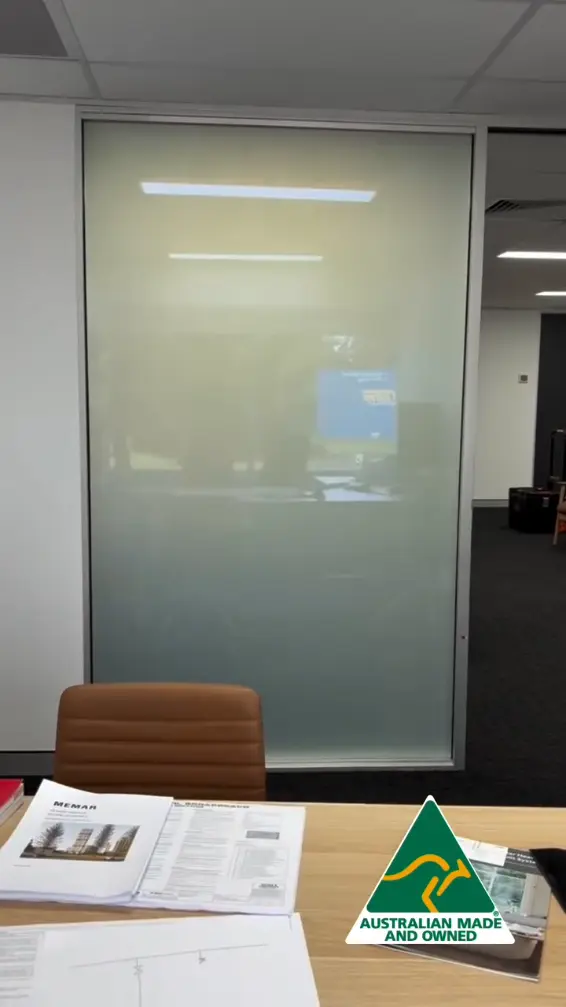
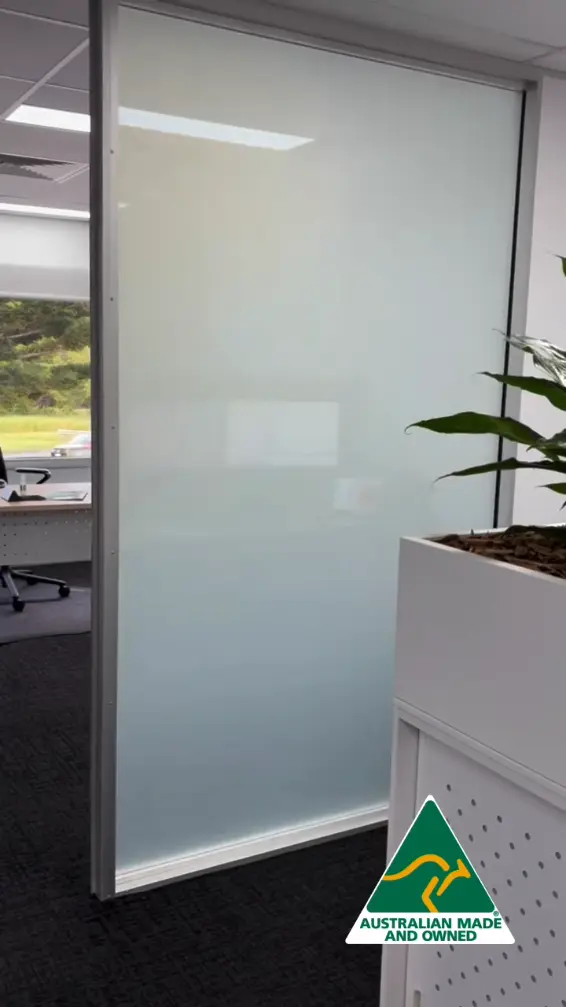
Smart Electronic Tint™'s Smart Film uses liquid crystals sandwiched between layers of adhesive film. Powered on, the crystals align and the glass turns clear - 88% visible light transmission. Powered off, they scatter light and the glass turns opaque - 11% transmission, 98% haze. The switch takes under 200ms to clear and under 10ms to opaque, so it feels instant.
Control is electrical, not manual - a wall switch, timer or building-management system triggers it. UV blocking is 99%+ in both states, with a 150-degree viewing angle so the glass reads correctly from an angle, not just straight on.
Here's what that looks like on a real commercial job.
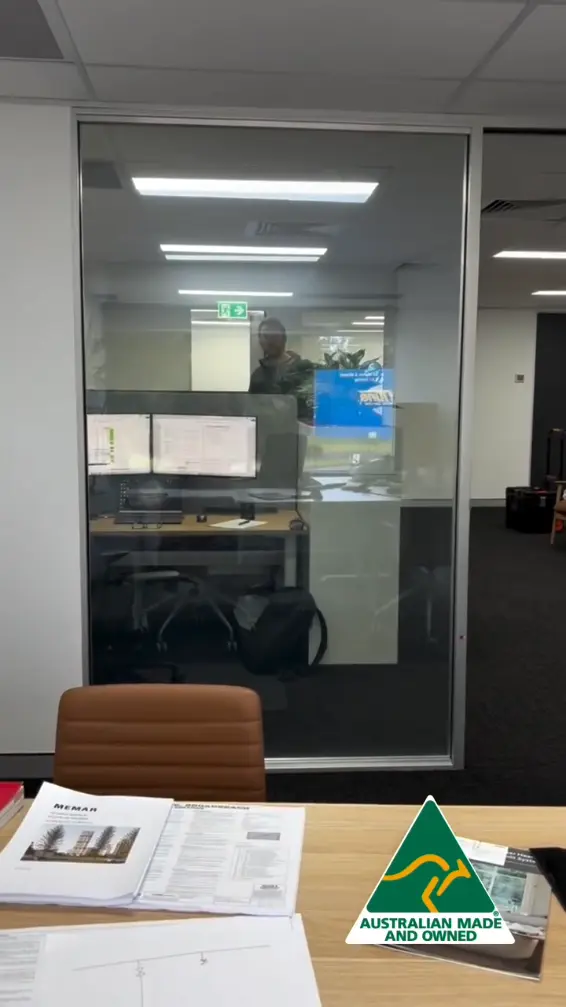
Open & Transparent
Private & Secure
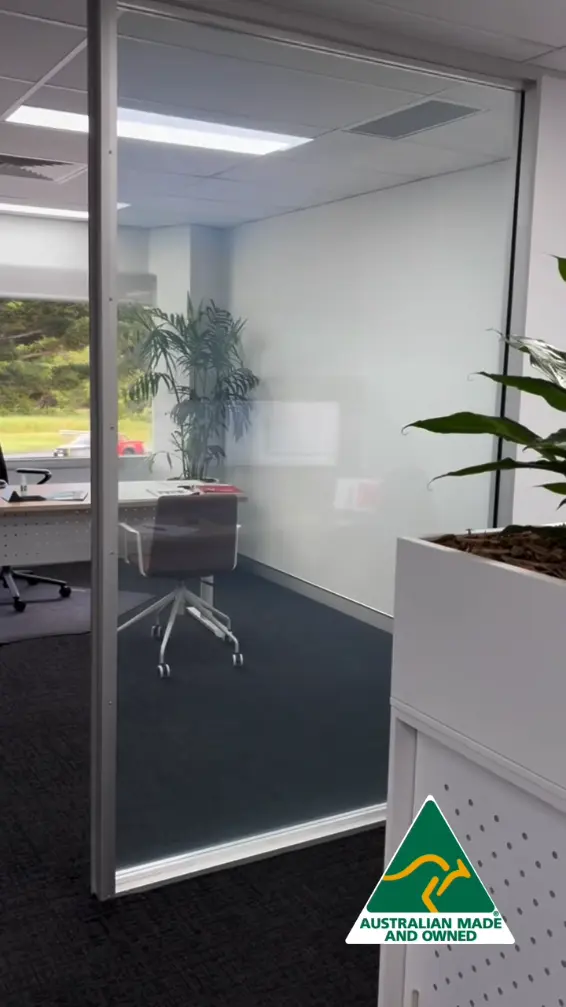
Open & Transparent
Private & Secure
Commercial - Office Partition
Internal Glass Office Partition
Application
Full Height Glass Partition
Location & Scope
Bussiness Info
Commercial Privacy Problems Smart Film Solves
- No privacy in glazed meeting rooms. Smart film switches the glass to opaque on demand - no blinds or curtains.
- Open-plan offices need occasional enclosure. Close one partition for a call, then open it back up.
- Replacing the glazing isn't practical. Smart film applies to suitable existing glass instead.
- Blinds block light you don't always need blocked. Smart film keeps 88% light transmission until you switch it off.
Smart Film vs Traditional Window Tinting
Smart film and traditional window tinting solve different problems. Traditional tint is a fixed, passive film that permanently reduces heat, glare and UV once applied - it doesn't switch states and doesn't need power. Smart film is switchable: it toggles your glass between clear and opaque on demand, using an electrical current. If your priority is blocking heat and UV, traditional tint is usually the simpler, lower-cost fit. If your priority is controlling privacy and visibility on demand, smart film is built for that.
Light control
Switches between 88% clear and 11% opaque, on demand
Fixed reduction, set once at installation
Privacy
On-demand - toggle it when you need it
Constant - same level all day, every day
Power required
Yes - 48-65V AC
No
Typical purpose
Switchable privacy for meeting rooms, partitions, glazed offices
Heat rejection, glare and UV reduction
Installation
Film application plus electrical coordination and commissioning
Film application only
Main cost driver
Glass area, panel count, electrical and control complexity
Primarily glass area
Best fit
Spaces that need privacy sometimes, visibility the rest of the time
Spaces that need constant heat, UV or glare control
The two aren't always substitutes - a building might use traditional tint on exterior-facing glass for heat control and smart film on internal partitions for privacy. We install Smart Film. If what you actually need is primarily heat or UV reduction rather than switchable privacy, tell us about your project and we'll point you in the right direction.
Commercial Spaces Where Smart Film Is Used
Six commercial environments use smart film most often. Each has its own dedicated page with fitout-specific detail.
- Offices, meeting rooms and boardrooms. Switch the glass to opaque during a meeting without leaving the room.
- Healthcare and clinical spaces. Move between an open, supervised layout and a private one. No clinical or regulatory claims made.
- Education facilities. Keep sightlines between spaces while closing off for a meeting or activity.
- Hotels and hospitality. Function rooms and internal partitions use the same switchable privacy.
- Retail and storefront glazing. Full visibility in trading hours, controlled privacy outside them.
- Government and public-sector spaces. Same switching function, no security-classification claims.
How Commercial Installation Works
Assessing Your Glass
Smart film applies to suitable existing glass, so replacement usually isn't needed. Suitability depends on glass type, condition, dimensions and electrical access - we assess your site before confirming a project. Panels are made up to 1800mm × 2700mm; larger glass uses multiple panels.
Electrical and Control
The film runs on 48-65V AC through a standard circuit, not specialised wiring. Control is usually a wall switch; timer or building-management integration is available if needed. Power use is under 5W per square metre. We coordinate wiring with your building's existing electrical work.
What Affects Commercial Smart Film Cost
Commercial pricing depends on your project, not a flat rate per square metre:
- Total glass area and panel count
- Glazing configuration - straight runs, multiple partitions, corners or irregular shapes
- Electrical complexity - a single switch versus multiple zones or building-management integration
- Site access and installation conditions
- Colour and finish selection
You'll get a quote after a site assessment, not a size-only estimate.
Why Professional Installation Matters
Poor glass assessment is the main risk - film applied to unsuitable or damaged glass won't perform or adhere properly. Panels are made to size, so accurate measurement matters, and the electrical work needs correct testing and commissioning before the space goes back into use. Your installation is covered by a 5-year workmanship warranty.
Who This Commercial Service Is For
This service suits:
- Business owners and facility managers planning a fitout or refit
- Architects and interior designers specifying glazing
- Builders and developers delivering a commercial fitout
- Property and asset managers upgrading an existing building
- Hospitality, healthcare, education and government facility teams
Builders, architects, interior designers and glass installers often bring us in as the film specialist on their project. Commercial project photography is being added to this page - get in touch and we'll talk you through recent installs.
Smart Electronic Tint™
Why Choose Us
Local to South-East Queensland
Based in Brisbane, we install across Brisbane, the Sunshine Coast and Gold Coast.
One Complete Project
Assessment, product selection, electrical coordination and installation, as one job.
Applies to Existing Glass
Smart Film applies to suitable existing glass - no glazing replacement.
Electrical Work Coordinated
Wiring is coordinated with your building's existing electrical work.
5-Year Workmanship Warranty
Your installation is covered by a 5-year warranty on workmanship.
Free Consultation & Quote
Every project starts with a free, no-obligation consultation and quote.
Frequently Asked Questions
Smart Film applies to your existing commercial glass and switches electrically between a clear, transparent state and an opaque privacy state.
Yes. It's designed to apply to suitable existing glass, so you don't usually need to replace it. Suitability depends on type, condition and electrical access, which we assess first.
Liquid crystals align when powered, letting light through at 88% visible light transmission. Power off and transmission drops to 11% - the glass reads as opaque.
Yes - glazed partitions around meeting rooms, boardrooms and open-plan offices are the most common commercial use. See <a href="/for-office/">Smart Film for Offices
No. Traditional window tinting is a fixed, passive film - it reduces heat, glare and UV permanently once applied, with no power needed. Smart film switches electrically between clear and opaque, so it controls privacy on demand rather than applying a constant tint level. See the comparison above.
No. Smart Film applies as a layer to your existing glass; Smart Glass is a switchable glazing unit built into the glass itself.
It depends on glass area, panel count, glazing configuration, electrical complexity and site access - not a flat rate. You'll get a quote after we assess your site.
Yes. Smart Film switches states using an electrical current on a standard circuit (48-65V AC), not a manual mechanism.
Clear state: 88% visible light transmission. Opaque state: 11%. IR blocking is 35% clear and 90% opaque.
Lifespan depends on the product spec, the glass, environment and maintenance, so we won't quote a fixed figure without assessing your project. Workmanship is covered by a 5-year warranty.
Most installations use a wall switch. Timer or building-management integration is possible if your project needs zoned or automated control.
Offices, healthcare, education, hospitality, retail and storefronts, government buildings, and specialised uses like event productions, projection and display cases.
Poor glass assessment affects how the film performs and adheres, and the electrical side needs correct wiring and commissioning. Professional installation covers assessment, sizing, electrical coordination and testing as one project.

.svg)

