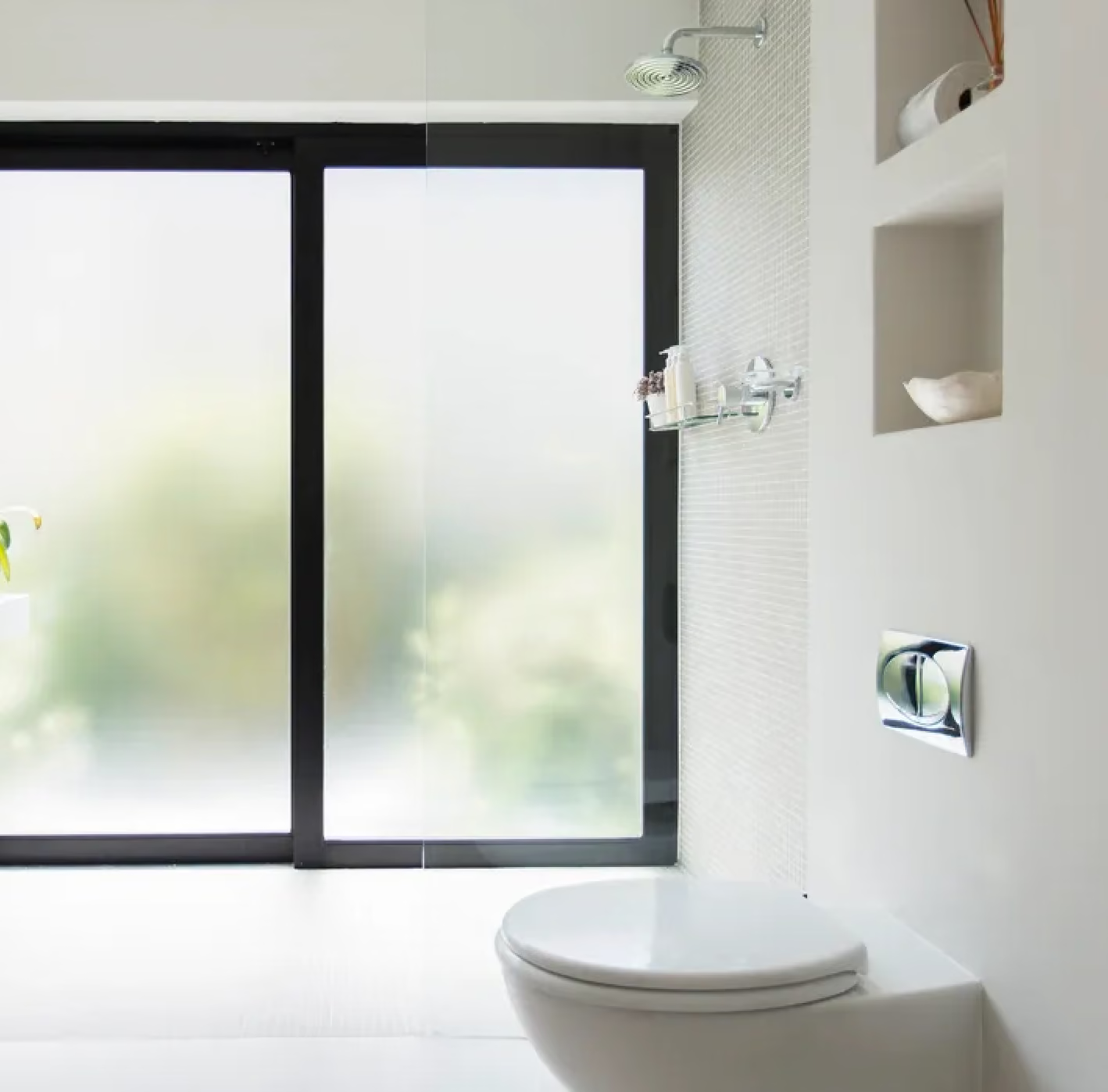
To measure windows for window film, measure the visible glass of every pane—width first, then height—in millimetres, and record the glass type and access for each one. Those few numbers decide how much film your job needs, which product suits your glass, and whether your quote holds on install day.
This guide applies to every film we install: conventional tint, frosting film, and switchable smart film, in homes and commercial buildings. It takes about five minutes per window, needs a steel tape and your phone, and gives you a measurement sheet you can send for a free quote.
Key figures
mm
the only unit to measure in
3 + 3
width and height readings per pane
8
steps for every pane
÷ 1,000,000
turns mm² into m²
1500 × 2700
mm, largest single smart film panel
<4 m
height of most serious ladder falls
What Should You Measure for Window Film?
You measure the visible glass: the area you can see between the rubber seals or timber beads, not the window frame. Window film bonds to glass only. The frame, the seal, and the glass edge hidden inside the frame take no film, so a frame measurement overstates your job and inflates your quote.
Three sizes describe every window, and only one of them matters for film:
Frame size: the outside of the window frame, used by window makers and blind suppliers.
Glass size: the full pane, including the edge hidden inside the frame, used by glaziers.
Visible glass size: the glass you can see and touch, used for window film.
Hook the tape on the inside edge of the seal or bead, and read to the inside edge opposite.Image source: Smart Electronic Tint. Data: Smart Electronic Tint™ measuring method.
Why Do Accurate Measurements Save You Money?
Accurate measurements save you money in five ways: a quote that holds, less film waste, a lower total cost, the right product first time, and a firm install date. Most quote changes on install day trace back to one wrong number, a missed pane, or glass nobody identified.
1. A Quote That Holds on Install Day
A quote built on visible glass sizes matches the job, so the price you approve is the price you pay. Frame sizes add the frame width to every pane. Across a home of 20 windows, that error adds square metres you'll never receive.
2. Less Film Waste
Film comes off a roll of fixed width, so your pane sizes decide how much of each roll becomes offcut. A pane narrower than the roll cuts cleanly. A pane wider than the roll gets rotated, if its height fits. A pane larger than the roll in both directions needs two pieces and a visible join.
Exact sizes let the installer plan cuts across all your panes and reuse offcuts on small glass.Image source: Smart Electronic Tint. Data: illustrative; roll widths vary by product.
3. A Lower Total Cost
Less waste and fewer surprises mean fewer billable hours and less film on your invoice. An installer who sees sizes, glass type, and access up front plans one visit, brings the right film, and books the right ladder or platform.
4. The Right Product First Time
Your glass details decide which film is safe to use, so recording them avoids a product that can't go on your glass. Smart film goes on most flat glass, including clear, toughened, laminated, double-glazed, and Low-E, up to 1500 × 2700 mm per panel. Dark absorptive tints may not suit some double-glazed units, and textured glass needs a check.
5. A Firm Install Date
Complete details let us quote clearly and book a firm date instead of a second site visit. Smart film is made to size, with a typical wait of 1–2 weeks, so confirmed sizes start that clock sooner.
What Tools Do You Need to Measure Glass?
You need five things: a steel tape measure marked in millimetres, a measurement sheet or phone notes, a phone camera, a torch, and a stable step ladder for high glass. A cloth sewing tape stretches, and a laser measure reads frame to frame, so both give the wrong number for film.
Steel tape (5 m or 8 m): rigid enough to span a pane without sagging.
Measurement sheet: use the template in this guide, or your phone's notes app.
Phone camera: one photo per pane, with the tape in shot.
Torch: lights up the etched stamp in the glass corner.
Step ladder: for glass above head height, used on level ground with someone nearby.
Stay safe on ladders
SafeWork NSW notes that most serious and fatal falls are from less than 4 metres, and Workplace Health and Safety Queensland lists ladder instability and stepping on or off as common causes. Skip any pane you can't reach safely and mark it "high access" on your sheet. We measure it on site.
How to Measure Windows for Window Film in 8 Steps
Measure each pane in eight steps: number it, measure width three times, measure height three times, write it down, note obstructions, identify the glass, record access, and photograph it.
Work one wall or room at a time, left to right, so no pane gets missed.
1. Number Every Pane
Sketch each wall or room as boxes and give every pane its own number. A sliding door is two panes. A window with a fixed pane and an opening sash is two panes. Numbering stops "the three bedroom windows" turning into four on install day.
2. Measure the Width Three Times
Measure the visible glass width at the top, middle, and bottom, and record the largest. Frames and older buildings are rarely square. Film must cover the widest point, so the largest reading is the one that counts.
3. Measure the Height Three Times
Measure the visible glass height at the left, centre, and right, and record the largest. If two readings differ by more than 5 mm, write "out of square" next to the pane. That note helps the installer plan the trim.
Six quick readings show whether the pane is square, and the largest pair goes on your sheet.Image source: Smart Electronic Tint. Data: example readings.
4. Write Width × Height in Millimetres
Always write width first, then height, in millimetres: 1206 × 1501 mm. Centimetres lose detail, and swapping width and height changes how the film is cut from the roll. One unit and one order across the whole sheet stops any mix-up.
5. Note Obstructions on the Glass
Record anything fixed to or through the glass: handles, locks, security bars, alarm sensors, stickers, and old adhesive. Film is cut around fixed items, and old stickers or film need removal first. Old tint removal is part of our service, so note it and we'll quote it.
6. Identify the Glass
Check the etched stamp in a bottom corner of the pane, and note whether the glass is single or double-glazed, toughened or laminated, tinted, textured, or already filmed. Australian safety glass is tested to AS/NZS 2208 and carries a permanent mark, often a T for toughened or an L for laminated. No stamp usually means ordinary annealed glass. To spot double glazing, hold a torch to the glass and count the reflections: two pairs suggest two panes.
A photo of the stamp tells the installer more than any description of the glass.Image source: Smart Electronic Tint. Data: AS/NZS 2208 marking conventions; layouts vary by maker.
7. Record Location and Access
Write the room, the floor level, and how high the glass sits above the floor or ground. Second-storey glass, stairwell voids, and shopfront transoms may need a tall ladder, scaffold, or an elevated work platform. Note furniture, joinery, or plants in front of the glass, so the install day starts with clear access.
8. Photograph Each Pane
Take one photo of each pane with the tape measure in shot, plus a close-up of the glass stamp. Photos confirm the glass type, the frame style, and any obstructions. Name each photo with its pane number so it matches your sheet.
How Do You Measure Different Window and Door Types?
Every window and door type is measured as separate panes of visible glass; what changes is where the glass hides behind sashes, interlocks, and frames.
Use the table to check your type, then read the notes for the four that cause most errors.
Window or door type
What to measure
Common mistake
Fixed window
One pane of visible glass
Measuring the frame
Sliding window or door
Each panel's visible glass, with the door closed
One size for both panels
Awning or casement
Each sash with the window closed
Measuring with the sash open
Double-hung (sash)
Upper and lower sash separately
Missing the meeting rail overlap
Hinged or French door
Each glass insert, inside the beads
Measuring the door leaf
Louvres
One blade, then count the blades
Measuring the whole louvre frame
Shopfront or curtain wall
Each pane between mullions
One size for a whole facade
Internal partition
Each pane, plus the door glass
Forgetting the door
1. Sliding Doors and Windows
Measure each panel separately with the door fully closed, from seal to seal on the glass you can see. Where the two panels overlap, the interlock hides part of each pane. Measured with the door open, the overlap disappears from one panel and your width runs long.
Fixed and sliding panels often differ by a few millimetres, so measure both.Image source: Smart Electronic Tint. Data: illustrative.
2. Awning, Casement, and Hinged Glass
Measure opening sashes and glass doors closed, on the room side, inside the beads that hold the glass. A door leaf or sash frame is not the glass size. On French doors with several small panes, measure one pane and count how many are the same, then measure any that differ.
3. Shopfronts and Large Commercial Glass
Measure every pane between mullions and transoms, and flag any pane wider than 1.5 m or taller than 2.7 m. Large panes may exceed the film roll, which means a planned join. For smart film, panes larger than 1500 × 2700 mm take more than one panel. Commercial sites need notes on trading hours, access windows, and building management contacts. See our commercial smart film page for fit-out projects.
4. Internal Glass Partitions and Doors
Measure each partition pane and each glass door separately, and note which side of the glass faces the room that needs privacy. Frameless glass has no bead, so measure the full pane and note "frameless". For smart film, note the nearest power point and where a wall switch could go.
Glass That Needs a Check Before You Measure
Textured, patterned, curved, cracked, and wet-area glass needs a specialist check before anyone quotes film on it. Film bonds best to a smooth, flat face. Glass inside a shower zone takes smart glass, not film. Measure these panes anyway, label them, and send photos.
How Do You Calculate Glass Area in Square Metres?
Multiply width by height in millimetres, then divide by 1,000,000 to get square metres. A 1200 × 1500 mm pane is 1,800,000 mm², or 1.80 m². Add every pane to get your total glass area, the first number any film quote starts from.
Pane
Width × height (mm)
Quantity
Area (m²)
1. Bedroom window
1200 × 1500
1
1.80
2. Bathroom window
900 × 600
1
0.54
3. Sliding door panels
1200 × 2100
2
5.04
4. Entry sidelights
300 × 2000
2
1.20
Total
6 panes
8.58
Glass area starts the quote, but it doesn't finish it. Film type, pane count, access, old film removal, and, for smart film, electrical work all move the final price. That's why we quote after a glass check rather than from a flat rate per square metre.
How Is Measuring for Smart Film Different From Tint and Frosting?
Conventional tint and frosting are cut from a roll and trimmed on the glass, while smart film is made to the exact size of each pane, so smart film measurements must be confirmed before it's made.
A tint offcut can be re-cut on site. A smart film panel made too small means a new panel, with its own lead time.
Three extra notes about power and switching let us plan the electrical side with your measurements.Image source: Smart Electronic Tint. Data: Smart Electronic Tint™ installation scope; layout is illustrative.
Electrical work for smart film is quoted separately, and you can have us arrange the electrician or use your own. Full panel and power data is on the smart film specifications page.
What Measuring Mistakes Inflate Quotes or Waste Film?
Eight measuring mistakes cause most quote changes, and each one takes seconds to avoid.
Measuring the frame: adds frame width to every pane and overstates your area.
Mixing units: centimetres and millimetres on one sheet turn 120 into 1200.
Height before width: swaps the cut direction and can push a pane past the roll width.
One size for "matching" windows: panes that look identical often differ by several millimetres.
Rounding down: film cut to a rounded-down size leaves a gap at the edge.
Measuring open sashes or doors: overlaps and interlocks disappear and widths run long.
Skipping the glass stamp: the wrong film on the wrong glass risks thermal stress or a failed product.
Forgetting access: an unplanned scaffold or platform adds a second visit and cost.
What Should You Send for an Accurate Window Film Quote?
Send a measurement sheet with one row per pane, one photo per pane, a close-up of each glass stamp, and your suburb. Copy this layout into a spreadsheet or your notes app.
Pane
Room
Width (mm)
Height (mm)
Glass
Notes
1
Bedroom 1
1206
1501
Double-glazed, no stamp
Faces street; old tint to remove
2
Ensuite
902
604
Toughened (T)
Outside shower zone
3
Living, sliding door
1198
2096
Toughened (T)
Fixed panel; power point 1.5 m away
4
Stairwell
-
-
Unknown
High access, not measured
A dash is fine: mark any pane you can't reach safely and we'll measure it on site.
Frequently Asked Questions About Measuring Windows for Film
Do I need exact measurements to get a window film quote?
No: careful measurements of the visible glass give an accurate indicative quote, and we confirm every pane on site before the job is finalised. The closer your numbers, the closer the indicative quote is to the final one. Mark anything you're unsure of, and send photos.
Should I measure the glass or the window frame?
Measure the visible glass, from the inside edge of the rubber seal or bead on one side to the inside edge on the other. Window film goes on the glass, not the frame, so frame sizes overstate the job.
Can I use a laser measure for window film?
A laser measure reads frame to frame across an opening, not the visible glass, so use a steel tape for each pane. A laser is useful for one thing: the height of high glass above the floor, for your access notes.
Does window film cover the glass right to the edge?
No: installers trim film a few millimetres short of the frame seal so the edge sits flat on the glass and doesn't lift. You still measure to the seal. The installer allows for the trim, so don't subtract it yourself.
How do I measure double-glazed windows for film?
Measure the visible glass on the room side, the same as single glazing, and note that the window is double-glazed. Film goes on the inside face. The note lets us check that the film suits the glass unit before we quote.
Do you re-measure before installing?
Yes: we check every pane on site before we finalise the job, and smart film is only made once the sizes are confirmed. Your measurements get you a fast, accurate indicative quote. Our check makes sure the final job matches your glass.
Next Steps: Send Your Measurements for a Free Quote
Send your measurement sheet and photos, and we'll reply with a clear quote and a firm install date once we've checked your glass. Our in-house team installs tint, frosting, smart film, and smart glass across Brisbane, the Gold Coast, and the Sunshine Coast, with a 5-year workmanship warranty on every install. Browse our projects to see the finished result on homes and offices.
Measured your windows?
Send your sizes and photos, and we'll turn them into a clear, written quote.
No minimum job size. Skip any pane you can't reach, and we'll measure it on site.